Biomass Pellet Machine: Market Trends & Buying Guide
Biomass Pellet Machine: Global Market Trends, Technology and Buyer Considerations
The biomass energy industry is evolving as manufacturers, energy producers, and agricultural processors seek practical ways to utilize biomass residues. A reliable Biomass Pellet Machine helps convert suitable raw materials into compact pellets that are easier to handle, store, and transport. For businesses planning to enter the biomass fuel market or expand existing production, equipment selection is becoming an important investment decision.
This article examines global market developments, pelletizing technology, essential technical parameters, manufacturing considerations, and the factors international buyers should evaluate before purchasing a biomass pellet machine.
1.Global Biomass Pellet Market: Data and Industry Developments
Global demand and production trends
According to the Food and Agriculture Organization of the United Nations (FAO), global wood pellet production recovered to approximately 48 million tonnes in 2024, matching the 2022 level. Around 31 million tonnes entered international trade. Europe and North America accounted for approximately 47% and 28% of global production, respectively, while the Asia-Pacific region increased its production share from 14% in 2020 to 22% in 2024.
Source: FAO, Global Forest Products Trade and Production in 2024.
These figures demonstrate the established scale of the wood pellet market. However, wood pellets represent only one segment of the broader biomass pellet industry, which also includes pellets made from agricultural residues and other suitable organic materials.
Factors shaping equipment demand
Several developments are influencing investment in pellet production equipment:
Industrial energy applications: Biomass pellets can provide process heat for suitable industrial applications, depending on fuel quality, combustion systems, and local regulations.
Agricultural residue utilization: Rice husks, straw, and other residues may offer feedstock opportunities where collection and processing are economically viable.
Wood processing and recycling: Sawmills and furniture manufacturers can evaluate pelletizing as a way to utilize suitable wood residues.
Regional market differences: Demand, fuel standards, subsidies, logistics, and feedstock prices vary considerably between countries.
The International Energy Agency's Renewables 2025 report identifies bioenergy as an important contributor to growth in renewable industrial heat. Nevertheless, investment decisions should be based on local market conditions rather than assuming that every biomass market is expanding at the same rate.
2. How Does a Biomass Pellet Machine Work?
A Biomass Pellet Machine uses mechanical pressure to compress prepared biomass into cylindrical pellets. The process generally involves raw material preparation, pelletizing, and downstream handling.
Raw material preparation
Depending on the feedstock, preparation may include crushing, drying, screening, and removing unsuitable contaminants. Moisture content and particle size should be assessed before selecting the equipment configuration.
For example, sawdust may require drying if its moisture content is too high, while larger wood chips generally need further size reduction. Rice husks and straw may require different preparation methods because their physical structures differ from those of wood residues.
Compression and pellet formation
In a typical ring-die or flat-die configuration, rollers force prepared material through holes in a die. Pressure and friction help form the material into pellets, which are then cut to the required length where the machine design provides a cutting mechanism.
Pellet quality depends on feedstock composition, moisture, particle size, die design, operating conditions, and other process variables. Therefore, a biomass pellet machine should be evaluated using the buyer's actual raw material whenever possible.
Cooling and finished-product handling
Fresh pellets may retain heat and moisture after compression. Depending on the production line, downstream equipment may include a cooler, screen, conveyor, and packaging system. These stages help prepare pellets for storage, transport, or further processing.
3. Key Technical Parameters for International Buyers
Choosing a Biomass Pellet Machine requires more than comparing motor power or advertised output. Buyers should review the following parameters with the supplier.
Parameter
What Buyers Should Confirm
Rated capacity | Expected output under specified operating conditions |
Main motor power | Installed power and local electrical requirements |
Die configuration | Ring die or flat die, according to the application |
Pellet diameter | Required finished pellet dimensions |
Raw material | Species, composition, particle size, and moisture content |
Wear parts | Die and roller material, serviceability, and replacement availability |
Control system | Operating controls, safety features, and monitoring requirements |
Line configuration | Whether crushing, drying, cooling, screening, and packing are included |
Actual capacity depends on the raw material, pellet specifications, machine configuration, and operating conditions. Buyers should request a clearly defined capacity basis rather than relying on an isolated maximum-output figure.
A suitable supplier should also clarify the scope of supply, installation requirements, spare parts, warranty conditions, and technical support arrangements before the purchase contract is finalized.
4. Product Structure and Manufacturing Quality
Main machine components
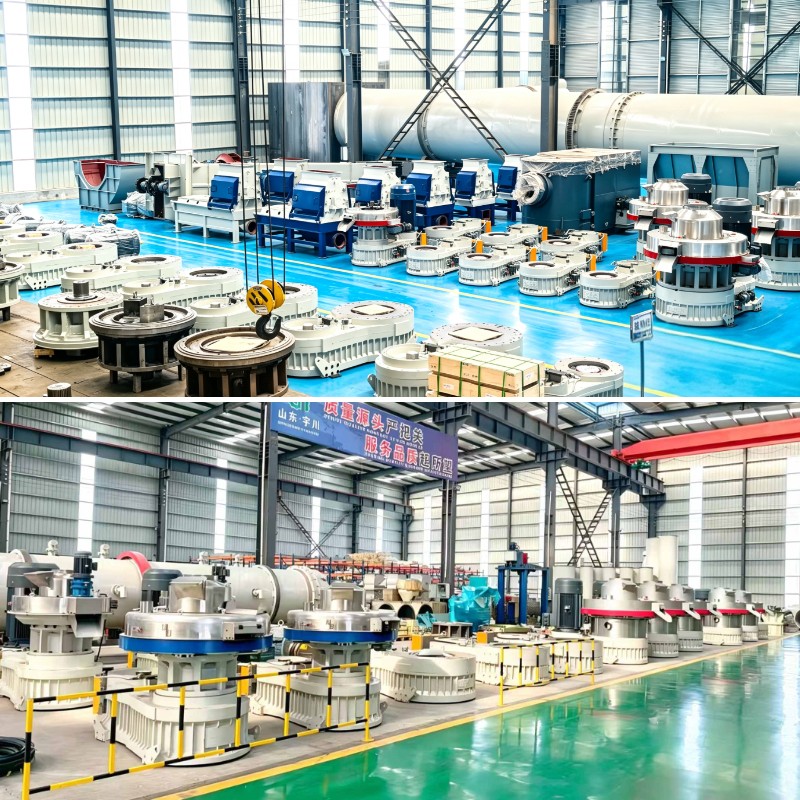
A typical biomass pellet mill may include a feeding system, pelletizing chamber, rollers, die, drive system, frame, and discharge arrangement. The exact structure varies between ring-die and flat-die machines.
The feeding system should provide a consistent material flow. Rollers and dies are critical wear components because they directly influence compression performance and pellet formation. The drive system must match the intended operating conditions, while guards and emergency-stop arrangements should be appropriate for the machine design.
Manufacturing and quality control
Reliable equipment begins with appropriate material selection, machining accuracy, assembly, and inspection. Key checks may include die-hole consistency, roller alignment, bearing installation, drive-system operation, and electrical safety.
Before shipment, buyers can request relevant inspection records, machine photographs, a trial-run video, and confirmation of the supplied configuration. Where practical, testing with representative raw material provides more useful information than a demonstration using an unrelated feedstock.
For international projects, packaging protection, lifting points, spare-parts identification, and installation documentation also deserve attention. These details can reduce uncertainty during transport, commissioning, and maintenance.
5. Suitable Raw Materials and Applications
A Biomass Pellet Machine may be suitable for different feedstocks when the machine configuration and material preparation are appropriate.
Wood-based materials
Sawdust, wood shavings, and certain processed wood residues are common feedstocks. Buyers searching for a Wood Pellet Production Machine should provide the wood species, particle size, moisture content, and required pellet diameter.
Agricultural residues
Rice husks, wheat straw, corn stalks, and peanut shells may offer opportunities for agricultural residue utilization. Their ash content, fiber structure, and compression characteristics can differ substantially, so compatibility should be verified before purchase.
Integrated production projects
A Biomass Pellet Production Line may include crushing, drying, conveying, pelletizing, cooling, screening, and packaging equipment. The appropriate configuration depends on incoming material conditions, target output, available space, and the desired level of automation.
A Sawdust Pellet Making Machine or Rice Husk Pellet Machine should not be selected solely because its product name matches the feedstock. Buyers should confirm processing suitability, expected output, energy requirements, and finished-pellet quality through technical evaluation or material testing.
6. What International Buyers Look for When Purchasing Equipment
Industrial buyers generally need a reliable production solution rather than a machine price alone. Several issues deserve particular attention.
Capacity and performance: Suppliers should explain the conditions behind rated output and identify any assumptions about raw material preparation.
Total project cost: The budget should account for auxiliary equipment, installation, shipping, electrical work, wear parts, and ongoing maintenance—not only the main machine.
After-sales support: Buyers should confirm warranty coverage, troubleshooting procedures, spare-parts lead times, and the availability of remote technical assistance.
Documentation and communication: Clear technical drawings, electrical information, operation manuals, and a well-defined quotation help reduce misunderstandings between supplier and buyer.
Feedstock compatibility: Material properties vary by region and season. A machine proven on one material may not deliver the same output on another.
For these reasons, international buyers should compare suppliers using consistent specifications and request clarification whenever capacity, configuration, or scope of supply is not clearly stated.
7. Frequently Asked Questions
Q1: What raw materials can a biomass pellet machine process?
It may process sawdust, wood shavings, straw, rice husks, and other suitable biomass materials, depending on machine design and feedstock preparation. Compatibility should be confirmed for the specific material.
Q2: Is a dryer necessary before pelletizing?
Not always. The need for drying depends on the incoming moisture content and the machine's operating requirements. A supplier should evaluate the raw material before recommending a dryer.
Q3: Can one machine produce pellets from different materials?
Potentially, but changing feedstocks may require adjustments to preparation methods, operating conditions, or die configuration. Performance should be verified for each important material.
Q4: What information is needed to obtain a quotation?
Provide the raw material type, moisture content, target capacity, pellet diameter, local voltage and frequency, and whether you need a standalone machine or a complete production line.
Discuss Your Biomass Pellet Production Project
Shandong Yuchuan Environmental Protection Equipment Co., Ltd. works with biomass processing equipment and production-line solutions. Buyers evaluating a biomass pellet machine are welcome to submit their feedstock details, production targets, and project requirements for technical discussion.
Contact our team to request a quotation, available technical documentation, machine configuration details, and a proposed production-line layout. Where testing arrangements are available, ask whether a raw-material trial can be organized before finalizing your equipment selection.
A well-defined technical inquiry is the first step toward selecting a practical biomass pellet production solution.