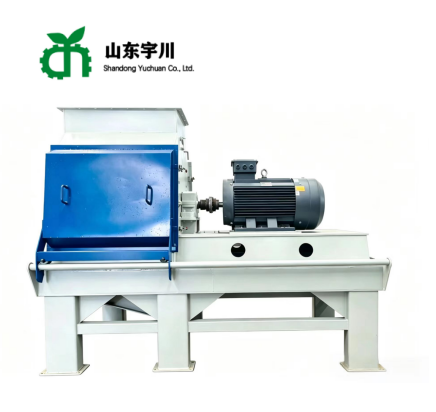
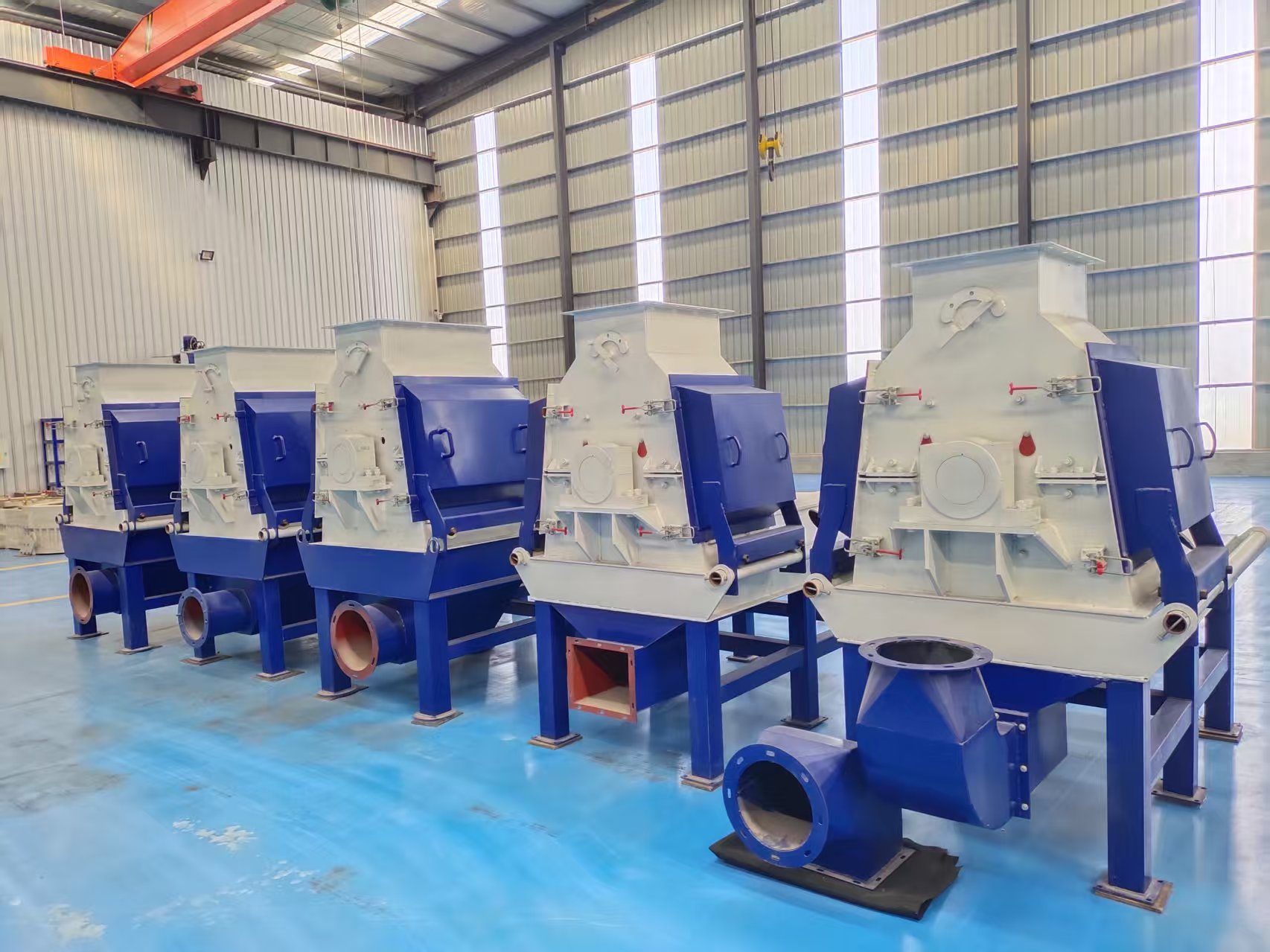
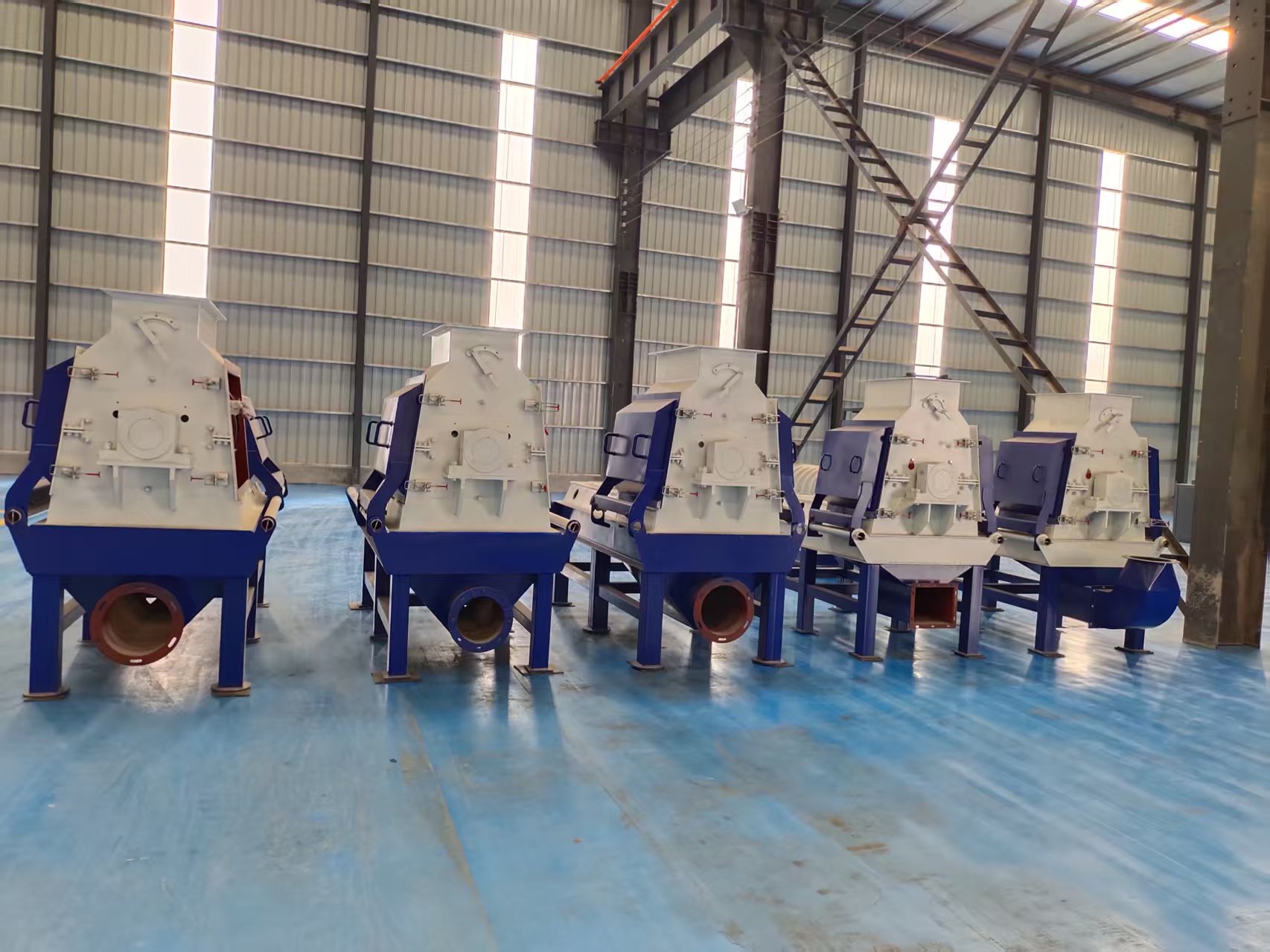
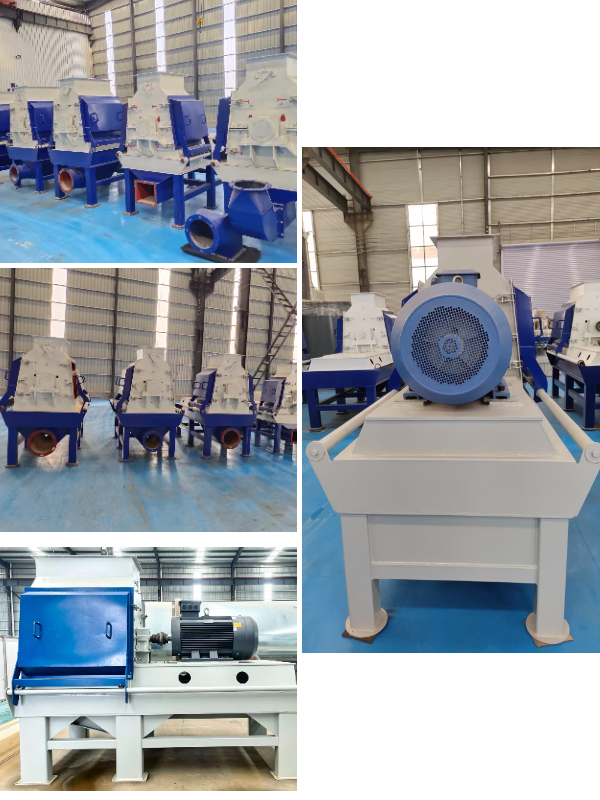
High-Efficient Hammer Mill
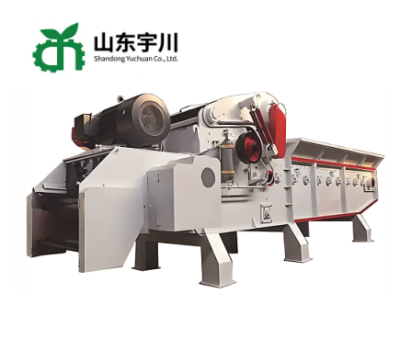
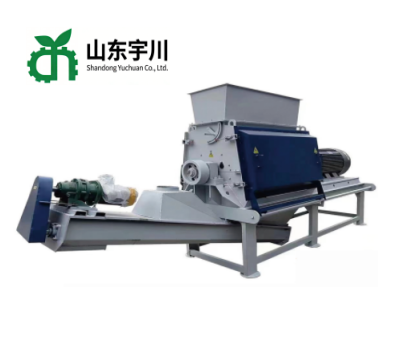
Symmetrically arranged hammer plates and optimized rotor design deliver high crushing efficiency, with less material residue and adjustable particle size by changing different sieves.
Equipped with dust removal interface for connecting bag filter, effectively lowering dust pollution and keeping clean working environment.
Stable structure, large processing capacity, widely applicable to biomass energy, feed processing and organic fertilizer production.
Product Overview
This high-efficiency hammer mill is the core pretreatment equipment of a biomass pellet production line. It is designed to work together with our 560 biomass pellet mill: raw materials are crushed into uniform fine particles of the size required by the pelletizing section, so that the pellet mill can run with a stable feeding load instead of being blocked or overloaded by coarse or uneven material. The machine can be used as a single unit in a small workshop, or connected with a belt conveyor, a bucket elevator and a pulse dust collector to form a closed, automatic crushing system for industrial production.
The crushing chamber adopts a water-drop shape. Compared with an ordinary straight chamber, this geometry removes the dead zones at the bottom and sides of the chamber and forms a secondary circulating crushing path, so material entering the chamber is repeatedly hit and sheared by the rotor before it is discharged through the screen. The rotor is a welded steel structure that has been dynamically balanced as a complete assembly; the hammers are arranged symmetrically on the hammer pins and can be turned over to use the second face. Screens of different apertures are interchangeable, which allows the finished particle size to be adjusted from coarse to fine without replacing the rotor or the chamber.
The main shaft is driven through a direct coupling, without a belt drive, so that power loss between the motor and the rotor is kept to a minimum. The housing is a sealed welded structure; when connected to a dust collector the working area stays clean and the fine powder that would otherwise fly out is collected as product rather than wasted. Voltage, frequency, screen aperture, hammer quantity and the feeding arrangement can all be customized, which makes the machine suitable for customers in different markets, from small farms that crush a few hundred kilograms per hour to medium industrial plants that require continuous three-shift operation.
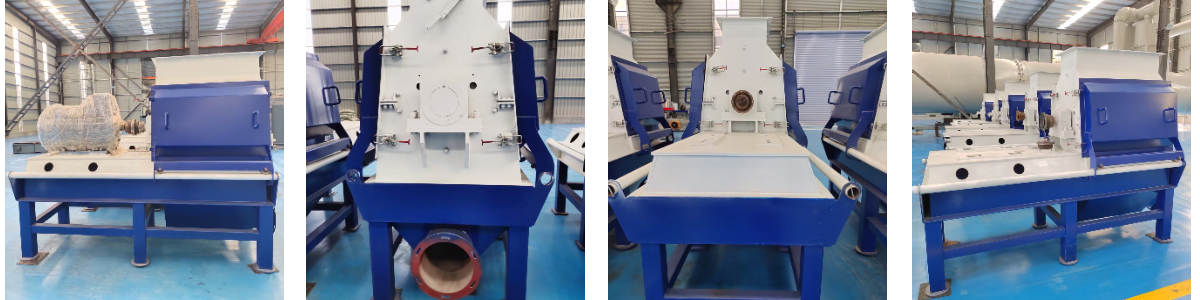
2. Key Advantages of the Hammer Mill
The advantages below are the points most often confirmed by customers who already run this machine in a pellet line; each of them has a direct effect on output, energy cost or maintenance cost.
1. The water-drop crushing chamber eliminates dead grinding zones, keeps material circulating inside the chamber instead of accumulating at the bottom, and therefore prevents sticking and blockage when wet or fibrous material is fed.
2. The dynamically balanced rotor runs smoothly with low vibration and low noise, which protects the bearings, reduces fatigue of the welded frame and allows long continuous operation.
3. Wear-resistant alloy hammers are symmetrical and can be reversed for double-sided use, so the service life of the wearing parts is doubled and the annual cost of spare hammers is halved.
4. The gap between the hammers and the screen is adjustable, and screens of different apertures are optional, giving flexible control of the finished fineness for different pelletizing standards.
5. Direct coupling transmission transfers power to the rotor with little loss and no belt slip, so the same output is reached with a lower installed power and a lower energy cost per ton.
6. The sealed welded housing, together with an optional pulse dust collector, creates a dust-free working area and prevents loss of fine product.
7. The optimized internal airflow carries qualified powder out through the screen quickly, which reduces repeated grinding of material that is already fine enough and further lowers power consumption.
8. A safety interlock is fitted to the inspection cover: the machine stops as soon as the cover is opened, preventing injury during screen or hammer replacement; the bearing housing is provided with a heat dissipation structure to control temperature rise.
9. The quick-opening inspection cover allows screens and hammers to be replaced in a short time without major disassembly, which shortens downtime and keeps the production line running.
10. Customized voltage and frequency, 380 V, 415 V, 440 V or 480 V at 50 Hz or 60 Hz, make the machine ready for export markets without an extra transformer.
No. | Industry / Field | Raw Materials | Application and End Product | Screen Aperture |
1 | Biomass pellet plants | Wood chips, sawdust, shavings | Feedstock for the 560 pellet mill; wood pellets | 3–5 mm |
2 | Sawmills and wood processing | Slab, edging, bark, offcuts | Wood powder for pelletizing; boiler fuel | 4–6 mm |
3 | Furniture and panel factories | Sawdust, shavings, MDF scrap | Fuel powder for boilers; briquette material | 3–5 mm |
4 | Crop residue collection | Wheat straw, rice straw, corn stalk, cotton stalk | Straw pellets; biomass fuel | 4–8 mm |
5 | Rice and grain processing | Rice husk, peanut shell, corn cob | Pellet fuel; biomass power plant fuel | 3–6 mm |
6 | Palm oil and coconut mills | Palm kernel shell, copra, palm fiber | Export pellet fuel; boiler fuel | 4–8 mm |
7 | Feed processing | Corn, soybean, bran, cake meal | Feed mash and crumble | 1.5–3 mm |
8 | Organic fertilizer plants | Dried manure, compost, straw ash | Organic fertilizer granules | 3–5 mm |
9 | Charcoal and briquette plants | Charcoal scraps, bamboo, coconut shell | Charcoal powder; barbecue briquette | 2–4 mm |
10 | Paper and packaging mills | Paper trimmings, wood waste, pulp reject | Boiler fuel; waste reuse | 4–8 mm |
11 | Mushroom substrate plants | Cottonseed hull, sawdust, straw | Culture substrate | 3–8 mm |
12 | Herb and spice processing | Dried herb, cassava chip, spice | Powder for further processing | 2–4 mm |
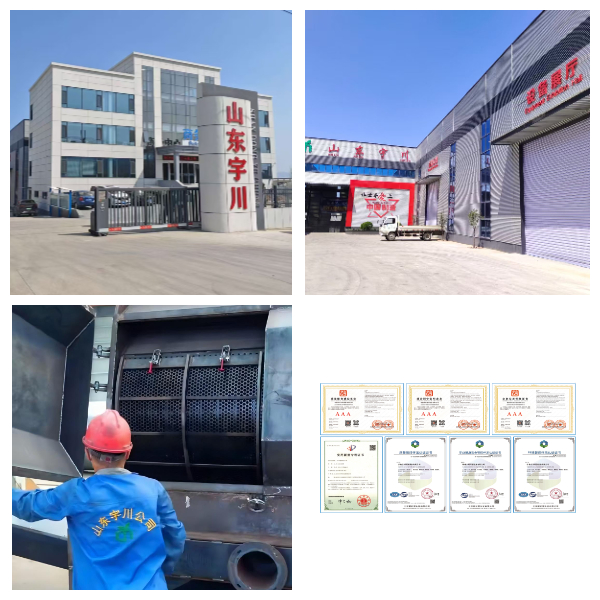
Manufacturing Process(加工工艺)
The quality of a hammer mill is decided long before assembly, in the selection of material, the welding of the chamber and the balancing of the rotor. The following steps describe how this machine is built, and what is controlled at each step.
1. Material selection and cutting. The chamber and frame are made of Q235B or Q345B steel plate, cut on a CNC plasma or flame cutting machine so that the blank size and the bevel for welding are accurate before fabrication.
2. Chamber fabrication and welding. The water-drop chamber is formed on a press brake and welded with CO2 gas shielded arc welding; stressed joints are welded with full penetration, and the welded seams are inspected for porosity and undercut before the next step.
3. Stress relief annealing. The welded housing is annealed as a whole to remove welding stress, which prevents deformation and cracking of the chamber during long-term vibration.
4. CNC machining. Bearing seats, flange faces and the coupling bore are machined on a CNC machine tool, with bore tolerance controlled to IT7 and surface roughness to Ra 1.6, so that the rotor and the bearing housing are concentric.
5. Rotor fabrication and dynamic balancing. The rotor shaft is made of 45# carbon steel, quenched and tempered to HB 220–250; the rotor is welded and fitted, hammer pins are made of 40Cr, and the complete rotor is dynamically balanced to G6.3 grade at working speed before assembly.
6. Heat treatment of hammers. Hammers are made of alloy wear-resistant steel, quenched and tempered to HRC 52–58, and shaped symmetrically so that both faces can be used.
7. Screen manufacturing. Screens are punched or machined from steel plate with apertures from 1.5 mm to 12 mm; holes are deburred and the frame is rolled to fit the chamber without gaps.
8. Assembly and clearance setting. Bearings are installed and their clearance adjusted, the hammer and screen gap is set according to the required fineness, and the rotor is turned by hand to confirm that there is no interference before power is connected.
9. Testing. Every unit runs without load for not less than two hours to check vibration, bearing temperature and noise, then is load-tested with actual material to confirm current, output and fineness; the motor is insulation-tested before delivery.
10. Surface treatment and marking. The machine is shot-blasted, primed and top-coated in the customer color, fitted with a nameplate showing model, power, speed and serial number, and packed for export.
FAQ
Q1. What raw materials can this hammer mill process?
Wood chips, sawdust, shavings, bark, slab and offcuts, wheat straw, rice straw, corn stalk and corn cob, rice husk, peanut shell, cotton stalk, palm kernel shell and similar biomass materials. Recommended moisture content is 12% to 15%; material that is wetter than this should be dried first, otherwise it will stick inside the chamber and reduce output.
Q2. What is the output capacity?
Capacity depends on the material, its moisture content and the screen aperture, and the figures below are for reference only. With a 4 mm screen and dry sawdust, output is roughly 2 to 3 tonnes per hour; with straw or rice husk of the same aperture it is lower. Please confirm the exact capacity for your material with our technical team when ordering, so that the machine can be matched to your pellet mill.
Q3. What finished particle size can be obtained?
Screens from 1.5 mm to 12 mm are available. For pelletizing, a 3 mm to 5 mm screen is normally used, giving a powder that is fine enough for the pellet mill to form dense pellets with a low breakage rate. Coarser screens are used where the crushed material is sold as boiler fuel or as a substrate.
Q4. Can the voltage and frequency be customized?
Yes. Motors can be wound for 380 V, 415 V, 440 V or 480 V and for 50 Hz or 60 Hz, and the control cabinet is supplied to match. Please state the local power supply when ordering.
Q5. Is the machine matched with the 560 pellet mill?
Yes. The standard configuration of this hammer mill is selected so that its output matches the feeding requirement of one 560 pellet mill; the screen aperture and the feeding conveyor are set accordingly. For lines with several pellet mills, a larger model or two units can be supplied.
Q6. How often do wearing parts need to be replaced?
Hammers can be turned over and used on the second face, so one set normally serves two working cycles. Screens are replaced when holes are worn or broken. Bearings are greased at the interval given in the manual. We keep hammers, screens, bearings and couplings in stock and can ship them by air within a short time.
Q7. How are noise and dust controlled?
The balanced rotor and the rigid frame keep noise at a normal industrial level, usually below 85 dB(A) at one metre from the machine. The housing is sealed, and when a pulse dust collector is connected the working area remains clean; the collected powder can be returned to the product.
Q8. What is included in the delivery and after-sales service?
Each unit is delivered with the motor, the coupling, one set of screens of the ordered aperture, one set of hammers, tools and the operation manual. The warranty period is twelve months for the main machine; installation guidance is provided by video or by an engineer on site when required.
| Model | YC1250-600 | YC1400-800 | YC1600-800 |
|---|---|---|---|
| Main motor power (kW) | 132 | 160 | 220 |
| Production volume (t/h) | 10–15 | 15–20 | 20–30 |