Rotary Dryer Sourcing in 2026: A Technical and Commercial Guide for B2B Buyers
Rotary Dryer Sourcing in 2026: A Technical and Commercial Guide for B2B Buyers
Moisture is among the least visible costs in bulk material processing, and among the most expensive. Every tonne of water entering a plant must be evaporated, and the industrial rotary dryer that does this usually decides whether a biomass pellet line, a mineral plant or a fertilizer granulation unit runs at rated capacity. This guide covers the market context, working principle, benchmarks and manufacturing practice behind a sound rotary dryer enquiry.
The Commercial Context Behind Rising Rotary Dryer Demand
PW Consulting values the global industrial driers market at USD 5.02 billion in 2025 and projects USD 6.93 billion by 2032, a compound annual growth rate of 4.7%. Within that total, rotary drum dryers were assessed at USD 1.53 billion in 2025, with a forecast CAGR of 5.8% through 2034. The rotary dryer keeps its share for a practical reason: it handles abrasive, fibrous and high-moisture feedstock at high tonnage while keeping maintenance intensity low.
Biomass Is the Fastest-Moving Demand Driver
The wood pellet market was valued at roughly USD 14.85 billion in 2025 and is forecast to reach USD 25.65 billion by 2032, growing 8.12% a year, while global pellet output reached some 53.5 million tonnes in 2025, about 10% above the previous year. Drying is the gatekeeper of that growth: sawdust and wood chips typically arrive at 50 to 63% moisture, whereas pellet presses need 10 to 15%. A rotary dryer that cannot hold outlet moisture inside that band caps the output of the whole line, whatever the press capacity.
What International Buyers Now Compare
Buyers compare fuel consumption per tonne of evaporated water rather than capital cost alone, ask for multi-fuel combustion chambers so the heat source follows local fuel prices, request documented trial runs before shipment, and treat spare-part lead time as contractual. Energy is the largest operating cost in a rotary dryer circuit, so a small efficiency gap compounds quickly over a multi-year production plan.
How an Industrial Rotary Dryer Works
The Basic Principle
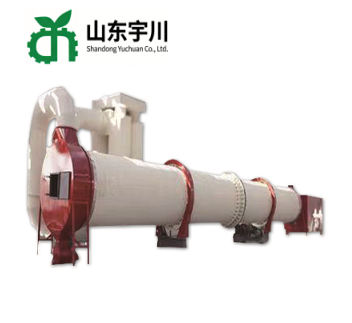
A rotary dryer is a slightly inclined rotating cylinder through which wet material travels while hot gas passes over it. Internal lifting flights raise and cascade the material through the gas stream, maximising contact area. Residence time follows drum length, inclination, rotation speed and gas velocity, while discharge moisture is set by inlet gas temperature and feed rate. Direct-fired rotary dryers bring material into contact with combustion gas; indirect designs use a heat-exchange shell where product purity rules out direct contact.
Why Three-Pass Configurations Dominate New Biomass Lines
In a three-pass rotary dryer, three concentric cylinders replace the single drum. Material enters the innermost cylinder and passes outward through the middle and outer shells while gas follows a serpentine path. Because the outer shell insulates the inner ones, heat loss falls sharply; manufacturers commonly report self-insulation thermal efficiency above 70%, against roughly 35% for a single-pass drum. The nested geometry halves the footprint of an equivalent single-pass rotary dryer and reduces civil works. In biomass service such a rotary dryer takes 50 to 55% feed moisture down to 10 to 15% in one pass, removing the need for a pre-dryer.
Heat Source, Airflow and Dust Control
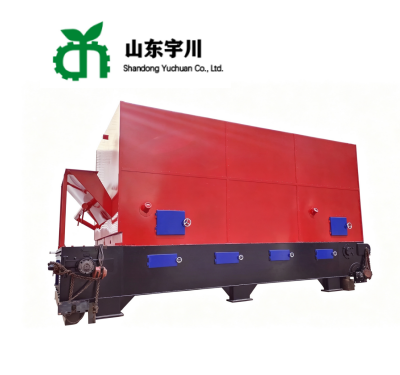
A rotary dryer combustion chamber is normally lined with refractory brick and accepts solid biomass, natural gas, LPG, diesel or coal, so the heat source follows local fuel economics. Direct-fired units may run gas inlet temperatures of 700 to 750 degrees Celsius, with drum gas velocity held between 0.5 and 2.5 m/s to limit entrainment of fines. A cyclone removes coarse dust and a bag filter or scrubber handles the remainder before the induced-draft fan discharges. Feed rate, drum speed and fan output are linked through a PLC with variable-frequency drives.
Performance Benchmarks to Compare on a Rotary Dryer Datasheet
Suppliers quote capacity in tonnes of wet feed per hour, a figure that conceals more than it reveals. Convert every rotary dryer offer to a common basis: water evaporated per hour, outlet moisture at a stated inlet moisture, and fuel consumption at a stated calorific value.
Table 1. Single-pass and three-pass rotary dryer configurations compared
Parameter | Single-pass drum | Three-pass rotary dryer |
Self-insulation thermal efficiency | About 35% | Above 70% |
Footprint for equal duty | Baseline | About 50% of baseline |
Moisture reduction, biomass at 50-55% feed | Often needs pre-drying | 10-15% in one pass |
Fuel options | Usually a single fuel | Multi-fuel combustion chamber |
Heat demand is the second benchmark. Evaporating one tonne of water normally requires 2.7 to 3.4 GJ of fuel energy, depending on gas temperature, insulation and exhaust heat recovery. At 3.0 GJ per tonne, a rotary dryer handling 1 t/h of wet feed and reducing biomass from 50% to 12% removes about 0.43 tonnes of water per hour, roughly 1.3 GJ per hour, which converts directly into fuel cost.
Manufacturing and Installation: How a Rotary Dryer Reaches the Site
Fabrication Essentials
Shells are rolled from Q235B or Q345B carbon steel plate, 12 to 20 mm thick depending on drum diameter, then joined by automatic submerged-arc welding and stress relieved. Riding rings, support rollers and thrust rollers are machined and aligned to close tolerances, because misalignment surfaces later as vibration and premature tyre wear. Drums are balanced before assembly, and material certificates, weld records, balancing reports and drawings travel with each rotary dryer. A no-load trial run before shipment catches alignment faults while they are still a factory issue.
Integration into the Production Line
A rotary dryer is rarely a stand-alone purchase. Scope usually extends to feed conveyor, combustion chamber, drum, discharge conveyor, cyclone, filter, fan, control cabinet and steel structure. Foundation drawings must state static and dynamic loads, and the layout has to leave access for roller and gear inspection. Where a rotary dryer feeds a pellet mill, outlet moisture is best controlled in closed loop, with an inline moisture meter trimming feed rate or inlet temperature.
Applications Beyond Biomass
The same rotary dryer principle serves mineral processing (sand, gypsum, slag, bentonite), fertilizer production (manure, compost, NPK granules), chemicals, sludge and food by-products such as brewers' grain and cassava residue. Material properties decide the internals: bulk density and particle size set the flight pattern, stickiness dictates lifters or chains, and allowable product temperature caps the gas inlet temperature.
Three Trends Reshaping Rotary Dryer Specification
Fuel Flexibility and Heat Recovery
Multi-fuel combustion is now a specification item rather than an option, because it lets a plant burn sawdust, bark or rice husk and switch to gas when residue supply or prices move. Exhaust heat recovery, preheating combustion air or pre-drying the feed, is the most direct route to lower specific fuel consumption in a rotary dryer line.
Closed-Loop Moisture Control
Moisture meters, variable-frequency drives and PLC logic have turned rotary dryer outlet moisture from an operator judgement into a controlled variable, cutting rejected batches, over-drying and energy per tonne.
Emissions and Compliance Documentation
Dust limits, noise levels and exposure rules differ by market, and buyers increasingly ask for test reports, CE marking where applicable and an ISO 9001 certificate. Emission control design for a rotary dryer, covering cyclone efficiency, filter area and stack height, should be agreed at quotation stage rather than retrofitted after commissioning.
Frequently Asked Questions
What moisture reduction can a rotary dryer achieve in a single pass?
For fibrous biomass, a three-pass rotary dryer typically takes 50 to 55% feed moisture down to 10 to 15%, around 40 percentage points in one pass; mineral and chemical feeds often finish below 1%. The endpoint depends on gas temperature, residence time and material behaviour, so confirm it with a test on your own material rather than a catalogue figure.
How much fuel does a rotary dryer consume per tonne of dried product?
Express consumption per tonne of water evaporated: 2.7 to 3.4 GJ is a representative band. Per tonne of finished product, a rotary dryer drying biomass from 50% to 12% removes about 0.43 tonnes of water, so fuel demand sits near 1.2 to 1.5 GJ. Multi-fuel burners, insulation and heat recovery push the figure toward the lower end.
What capacity range is available, and how is a rotary dryer sized?
Biomass models commonly cover 1 to 6 t/h of wet feed, while larger industrial rotary dryers reach several tens of tonnes per hour for mineral duty. Sizing starts from hourly wet-feed tonnage, inlet moisture and target outlet moisture; the required evaporation rate follows, and drum diameter, length, gas volume and fan power are derived in that order.
A Buyer's Checklist Before Requesting a Quotation
· A representative material sample with measured inlet moisture and bulk density
· Required hourly output, stated both as wet feed and finished product
· Target outlet moisture and the downstream process the rotary dryer feeds
· Available fuels, with calorific value and local price
· Required documentation, certification and spare-part stocking policy