Biomass Pellet Production Line
Fully automatic system for stable continuous production.
Compatible with wood, straw, bamboo and other biomass feedstock.
Energy-saving structure with high output and uniform pellets.
1. Product Overview
1.1 What the Line Consists Of
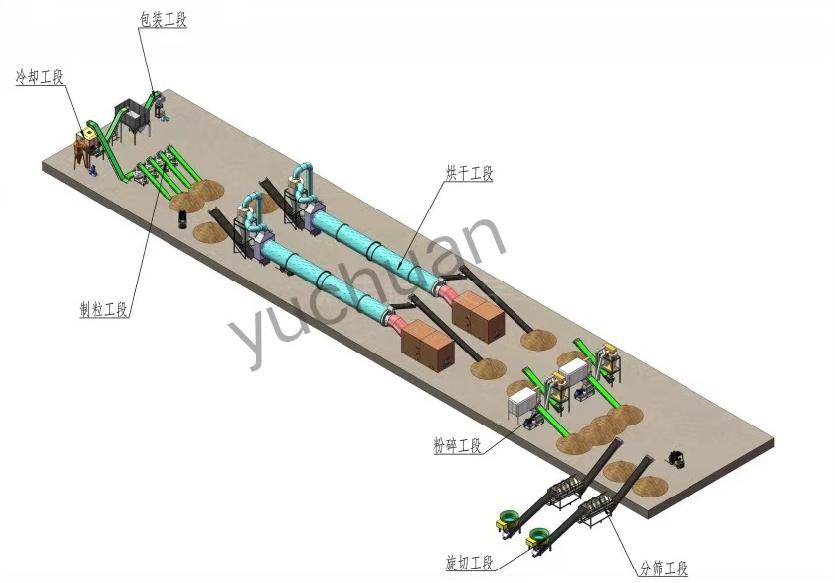
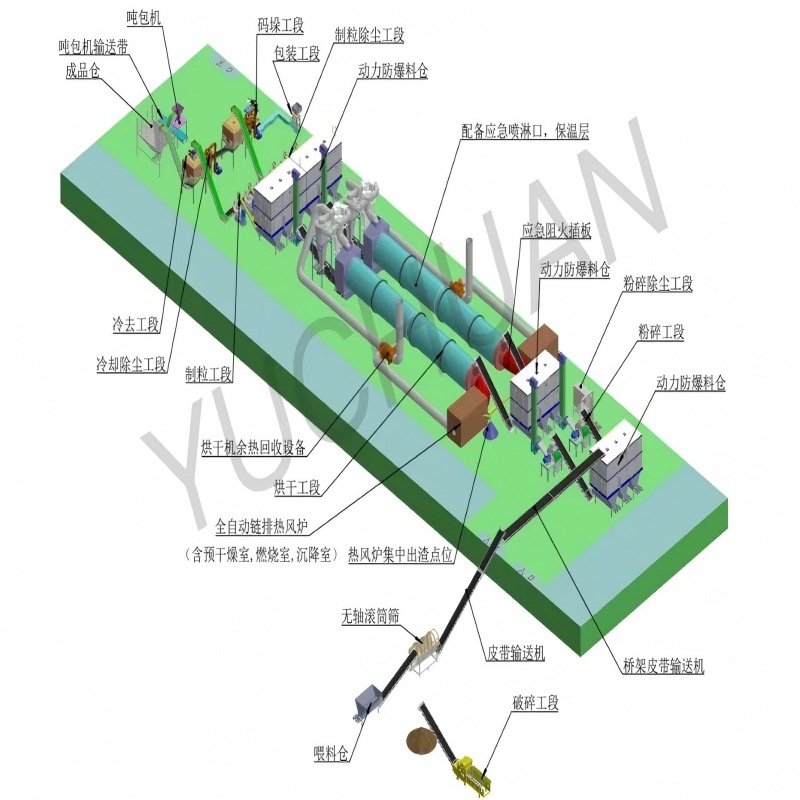
A biomass pellet production line is not a single machine but a set of equipment arranged in a fixed sequence, each section doing the preparation that the next section needs. The line described in this document is supplied as one package, from the reception of the raw material to the packed bag of pellets, and the capacity of each section is matched to the pellet mill so that no section becomes the bottleneck of the others.
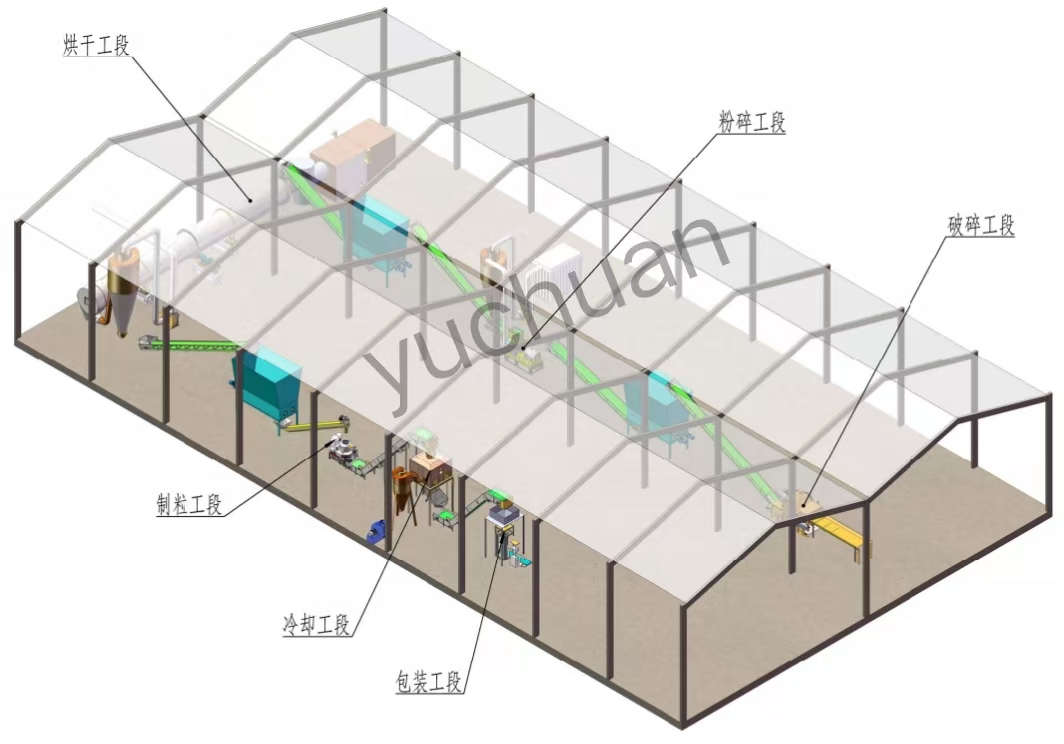
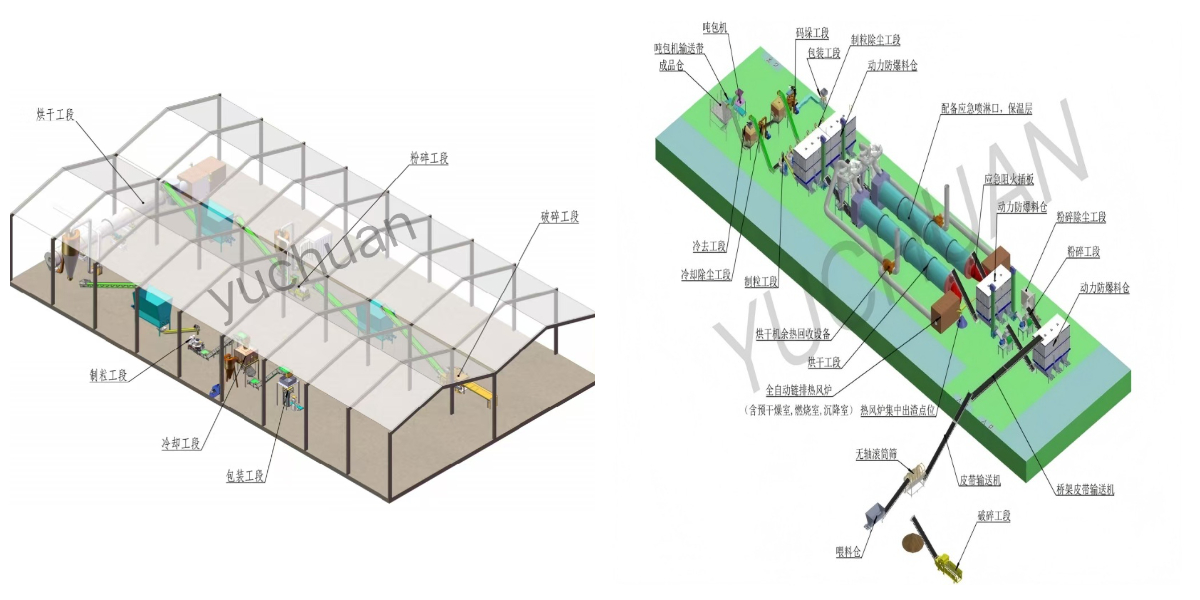
The sequence is: raw material reception and storage, crushing, drying, pelletizing, cooling, sieving, and packing, with dust collection and conveying equipment serving the whole line. The crusher reduces bulky material to a particle size the pellet mill can accept, the dryer brings the moisture down to the range in which the material can be compressed, the pellet mill forms the pellets under pressure, the cooler brings the pellet temperature down to ambient so that the pellet hardens without cracking, the sieve removes the fines and returns them to the process, and the packing section weighs and bags the finished product.
Each section can be supplied in different sizes and configurations, and the line can be built for a small workshop, for a cooperative plant, or for an industrial installation running three shifts. The die diameter, the number of rollers, the drive power, the dryer size and the packing arrangement are chosen from the working conditions rather than from a standard list, because the same nominal capacity means very different equipment on sawdust and on wet straw.
The line is also offered in partial configurations: a customer who already has a crusher can take the drying and pelletizing sections only; a customer who already has a pellet mill can take the crushing, drying and cooling sections. In each case the quotation states which sections are included and how the interfaces, that is the belt conveyors, the ducts and the electrical connections, are handled.
1.2 Raw Material Preparation Requirements
Three properties of the raw material decide the design of the line: particle size, moisture content and bulk density. Particle size determines the die and the roller configuration, because a pellet is formed by compressing the material in the die hole and an oversized particle will either block the hole or be pressed out as a weak pellet. Moisture determines the dryer and the conditioning of the material before the die, since water in the material turns into steam inside the die and cracks the pellet as it cools. Bulk density determines the volume of the silos and the conveyor, and it is the reason light material such as straw needs a larger handling system than its weight would suggest.
The usual preparation target is a particle size of 3 to 5 mm for wood material and 3 to 6 mm for straw, with moisture at 8% to 12% at the inlet of the pellet mill. Material outside these ranges can still be pelletized, but the die life, the output and the pellet durability all fall, and the operator compensates by reducing the feed rate, which is the same as losing capacity. Section 3.1 and Table 2 give the working figures for the main materials.
Where the raw material is a mixture, for example sawdust with shavings and bark, the mixture should be crushed to a uniform size and blended before drying, so that the dryer and the pellet mill receive a consistent feed. Blending is done in the storage silo or on the receiving floor, and it is a simple measure that removes most of the variation that otherwise appears as fluctuating pellet quality.
1.3 Line Configurations
The line is offered in three typical configurations. The compact configuration is built around one pellet mill with a crusher, a small dryer and a bagging scale, and is intended for workshops and farms that produce for their own use or for the local market. The standard configuration adds a buffer silo, a cooler with a sieve, a dust collection system and a semi-automatic packing section, and is intended for commercial production. The industrial configuration duplicates the crushing and pelletizing sections, adds automatic batching and a fully automatic packing line, and is intended for export production where the line has to run continuously and the downtime of one machine must not stop the whole plant.
In all three configurations the electrical control is centralized in one cabinet with interlocking between the sections, so that a stoppage downstream stops the feeding upstream instead of filling the equipment with material. The interlocks, the emergency stops and the motor protection are part of the supply, not an optional extra, because a line without them is a line that will be damaged by its first blockage.
2. Key Advantages of the Pellet Production Line
2.1 Advantages of the Complete Line
The advantages below are written from the point of view of the operator, because the value of a line is decided by how many hours per year it actually runs, and by how much of what it consumes comes back as saleable product.
1. All sections are matched to each other. The crusher, the dryer, the pellet mill, the cooler and the packing section are sized from the same working conditions, so the line reaches its rated output instead of being limited by one undersized section.
2. The line is supplied as one package with layout drawings, ducting, conveying equipment and a single control cabinet, which removes the interface problems that appear when equipment from different suppliers is assembled on site.
3. Interlocking between the sections prevents material from accumulating inside the equipment when a section stops, which protects the die, the dryer and the conveyors from blockage damage.
4. The dryer is fired with the plant own residue in the biomass configuration, so the fuel cost of drying is close to zero and the waste that cannot be sold as product is turned into the energy that dries the product.
5. The die and the roller assembly are selected according to the material, so the compression ratio matches the raw material and the pellet density is reached without overloading the main motor.
6. The cooler and the sieve work together: the cooler hardens the pellet and the sieve removes the fines, which are returned to the die instead of being sold as dust, so the yield of saleable pellets is higher.
7. Dust collection is included at the crushing, drying and cooling stages, so the workshop meets normal emission requirements and the collected powder is returned to the product.
8. The line can be built in stages. A customer can start with crushing and pelletizing and add drying, cooling and automatic packing later, and the layout leaves the space and the connections for the later sections.
9. Voltage, frequency, die size, packing weight and the language of the control panel are customized, so the line can be commissioned in the customer country without modification on site.
10. Spare parts for the die, the rollers, the hammers, the belts and the bearings are kept in stock, and the line is documented with a manual, a wiring diagram and a spare parts list, so maintenance does not depend on the supplier being on site.
2.2 Advantages of the Main Sections
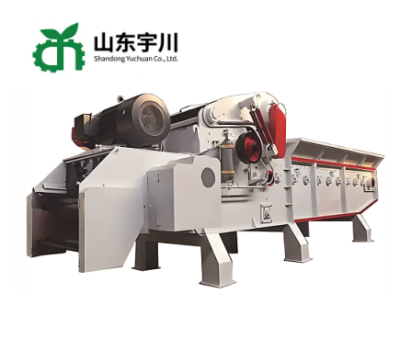
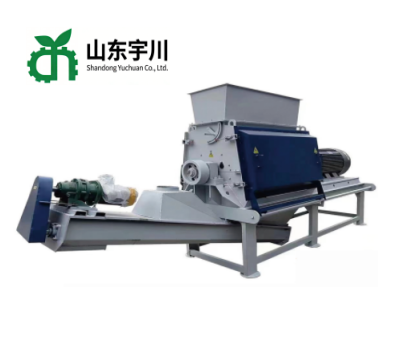
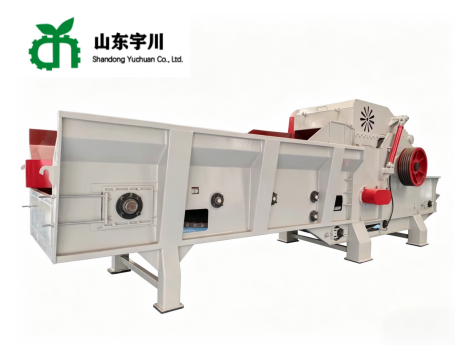
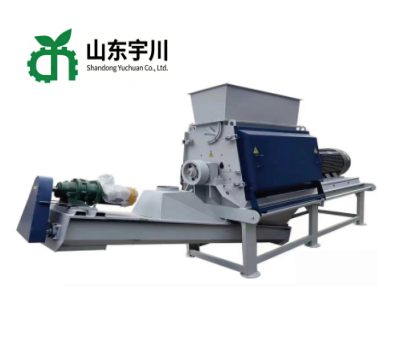
Crushing section. A hammer-type crusher with a water-drop chamber and reversible alloy hammers reduces wood chips, shavings, straw and shell to the size required by the die, with a screen change giving coarse or fine material for different products. The crusher is placed before the dryer so that wet material is crushed while it is still soft, which costs less energy than crushing dry material.
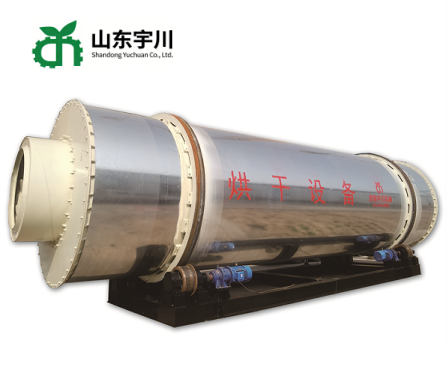
Drying section. A triple-pass or multi-channel drum dryer brings the material to 8% to 12% moisture, with the heat supplied by a burner fired with the plant residue, by gas or oil, or by waste heat. The dryer holds the outlet moisture stable when the incoming material changes, which is what allows the pellet mill to run at a constant feed rate.
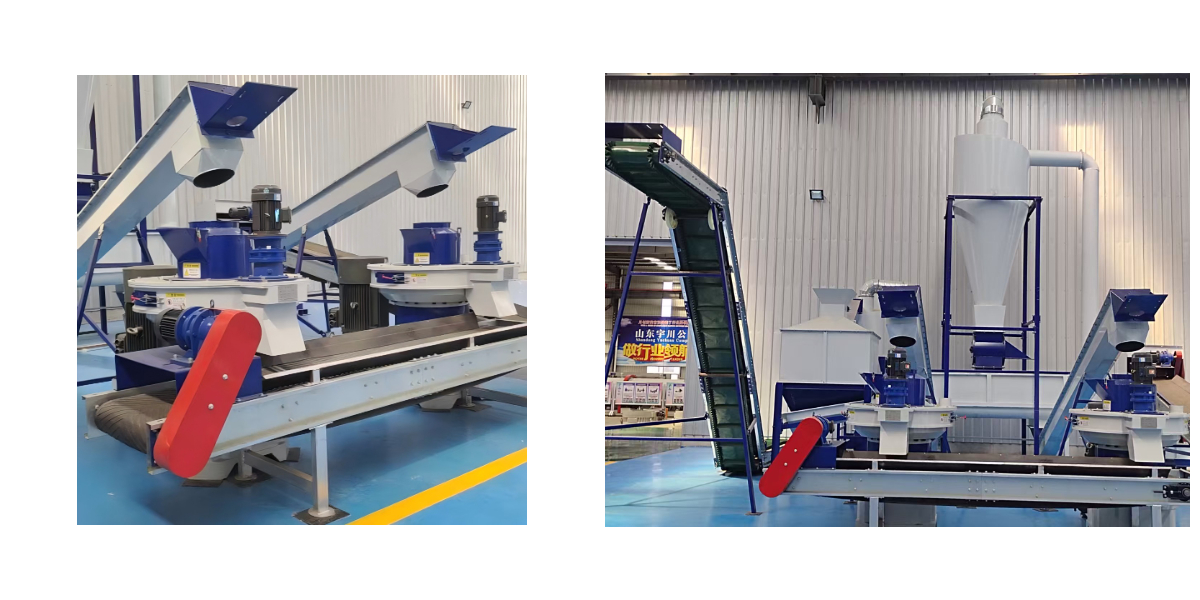
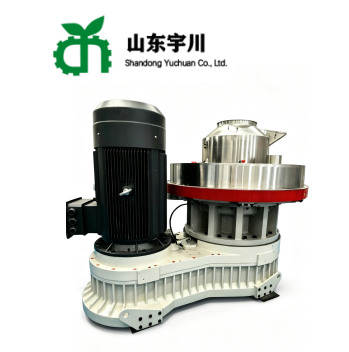
Pelletizing section. The pellet mill uses a ring die with two or three rollers, forced lubrication and a conditioner before the die. The die compression ratio is chosen for the material: a high ratio for wood, a lower ratio for straw and shell, so that the pellet is dense but the motor is not overloaded. The cutter sets the pellet length, and the die and the rollers can be changed for a different product.
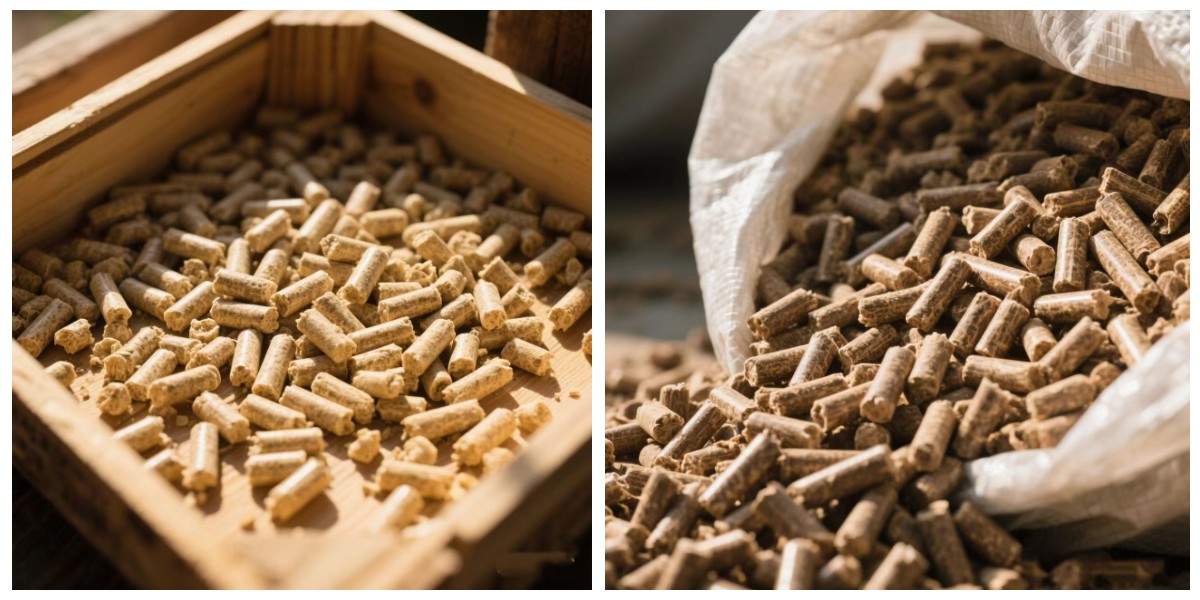
Cooling and sieving section. A counter-flow cooler brings the pellet from the die temperature to near ambient, and a vibrating sieve separates the fines and returns them to the process. Pellets that are packed hot continue to cool in the bag, condense moisture inside the bag and arrive at the customer soft and mouldy, which is the most common complaint in plants that omit the cooler.
Packing section. A weighing and bagging unit fills 15 kg, 25 kg or 50 kg bags or jumbo bags, with a sealing or stitching device and a belt conveyor to the storage area. The weighing accuracy and the bag presentation decide how the product is received in the market, and they are part of the line rather than an afterthought.
3. Process
3.1 Pellet Production Process Flow
The process flow of the line is fixed, and every section exists because of a property of the material that the next section cannot tolerate. The steps below describe the flow as it is commissioned on site.
1. Raw material reception and storage. Material is received on a concrete floor or in a hopper, checked for contamination such as stones, metal and plastic, and stored in a silo or a covered shed. Storage is kept short for wet material, because wet biomass heats and composts in the pile and loses calorific value.
2. Crushing. A hammer crusher reduces the material to 3 to 6 mm. The screen aperture is set according to the die and the product, and the hammers are turned over when the wear reaches the limit, so that the particle size stays uniform through the campaign.
3. Drying. The material enters the drum dryer and leaves at 8% to 12% moisture. The drum speed, the burner output and the feed rate are adjusted together during commissioning, and the outlet moisture is checked by a moisture meter or by oven test at the start of each shift.
4. Conditioning before the die. Where the process requires it, steam or water is added in a conditioner to soften the material and to bring it to the temperature at which it compresses best. Wood material normally needs a small amount of water; straw and shell behave better with a short steam conditioning.
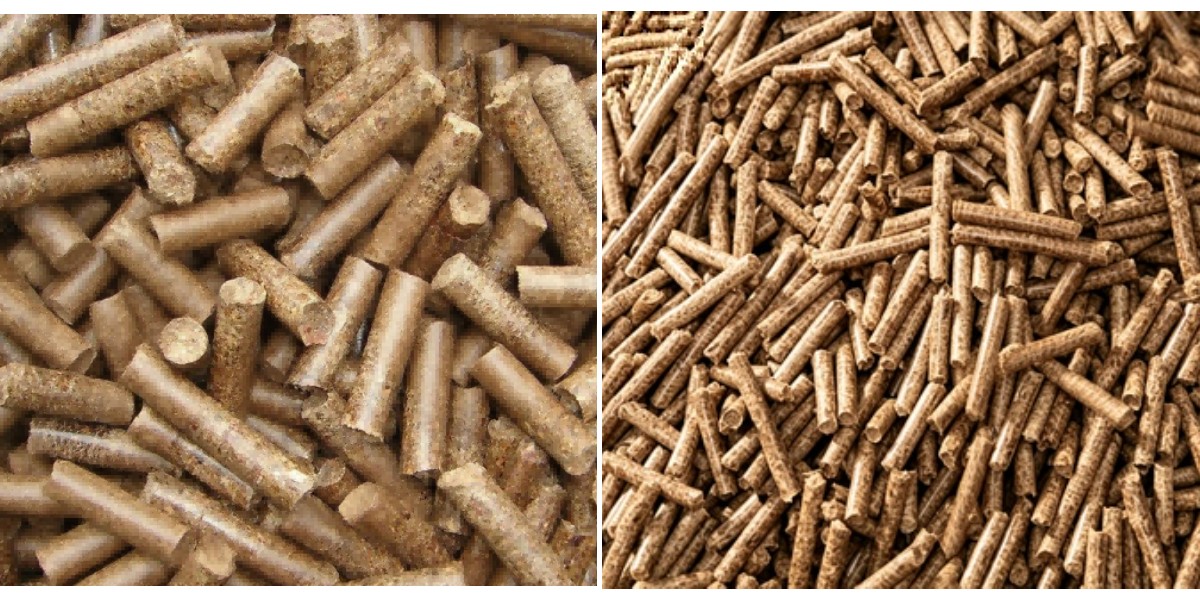
5. Pelletizing. The material is pressed through the ring die by the rollers, and the cutter trims the extruded pellet to the required length. The operator watches the die temperature, the main motor current and the pellet appearance, and adjusts the feed rate accordingly.
6. Cooling. The hot pellets pass through the counter-flow cooler, where ambient air removes the heat and part of the surface moisture. The pellet leaves the cooler at a temperature close to ambient and with a hardness that allows it to be handled without breaking.
7. Sieving and fines return. The cooled pellet passes over a vibrating sieve. Fines and broken pellets are separated, returned to the die or to the dryer, and the finished pellet goes to packing.
8. Packing and storage. The pellet is weighed into bags or jumbo bags, sealed, and stacked in a dry store. Bags are not stacked against a cold wall, because condensation on the wall migrates into the product.
9. Dust collection and cleaning. Dust from the crusher, the dryer and the cooler is collected by a bag filter and returned to the product; the floor is cleaned at the end of the shift, because dust accumulated under the equipment is both a fire risk and a loss of product.
3.2 Equipment Manufacturing Process
The reliability of the line depends on how the main machines are built. The process below applies to the crusher, the dryer and the pellet mill, which are the three machines that carry the load of the line.
10. Material selection. Frames and chambers are made of Q235B or Q345B plate, the pellet mill ring die is made of alloy steel and the rollers of forged alloy steel, and each heat number is recorded so that a failed part can be traced.
11. Cutting and forming. Plate is cut on a CNC plasma or flame cutting machine, the crusher chamber is formed on a press brake, and the dryer shells are rolled on a plate rolling machine to the calculated diameter.
12. Welding. Chambers and shells are welded with CO2 gas shielded or submerged arc welding under a fixed procedure; stressed joints are welded with full penetration and inspected for porosity and undercut.
13. Stress relief. Welded housings and dryer shells are annealed to release welding stress, which prevents cracking under the vibration and the heat of continuous operation.
14. Machining. Bearing seats, die seats, flange faces and coupling bores are machined on CNC equipment, with bore tolerance to IT7 and surface roughness to Ra 1.6, so that the rotor, the die and the drive run concentrically.
15. Heat treatment. Hammers are quenched and tempered to HRC 52-58; the ring die is quenched and tempered, then the holes are drilled or punched and the die is polished; the rollers are hardened to resist the abrasion of the material.
16. Dynamic balancing. Crusher rotors and pellet mill rotors are dynamically balanced at working speed to G6.3 grade before assembly, which is the basis of low vibration and long bearing life.
17. Assembly. Bearings, shafts, dies, rollers and drives are assembled on the frame, clearances are set to the drawing, and the machine is turned by hand to confirm free rotation before power is connected.
18. Testing. Each machine runs without load to check vibration, temperature and noise, and the pellet mill is load-tested with material to confirm the output, the current and the pellet quality at the design setting.
19. Surface treatment and packing. The machines are shot-blasted, primed and top-coated, nameplates with model, power, speed and serial number are fitted, and the equipment is packed in sections with the assembly drawings and the electrical diagrams enclosed.