Cow Manure Dryer Helps Livestock Farms Upgrade Waste Treatment and Organic Fertilizer Production
From Livestock Waste to Valuable Resources
With the continuous expansion of intensive livestock farming, the efficient treatment and utilization of cow manure has become an important issue for modern farms. Fresh cow manure normally contains a high amount of moisture, making it difficult to transport, store, process, or use directly as a commercial fertilizer.
A professional Cow Manure Dryer provides an effective solution by rapidly reducing moisture and converting wet manure into a drier, easier-to-handle material. Instead of treating manure simply as agricultural waste, modern drying technology helps livestock farms turn manure into a valuable resource for organic fertilizer production, soil improvement, and biomass utilization.
This shift from waste disposal to resource recovery is creating new demand for efficient cow manure drying equipment in dairy farms, cattle farms, organic fertilizer plants, and agricultural waste treatment projects.
Why Is Cow Manure Drying Important?
The moisture content of fresh cow manure can vary significantly depending on feeding methods, farm management, cleaning systems, and collection conditions. Excessive moisture increases transportation costs and makes subsequent processing more difficult.
Drying can provide several practical benefits:
Reduce the weight and volume of wet manure
Improve storage and transportation conditions
Reduce odor and secondary pollution risks
Improve the efficiency of fertilizer processing
Prepare manure for composting, pelletizing, or further processing
Increase the commercial value of processed organic fertilizer materials
For large-scale farms, these advantages can directly influence operating efficiency. A properly designed Cow Manure Dryer therefore plays an important role in the overall manure management system.
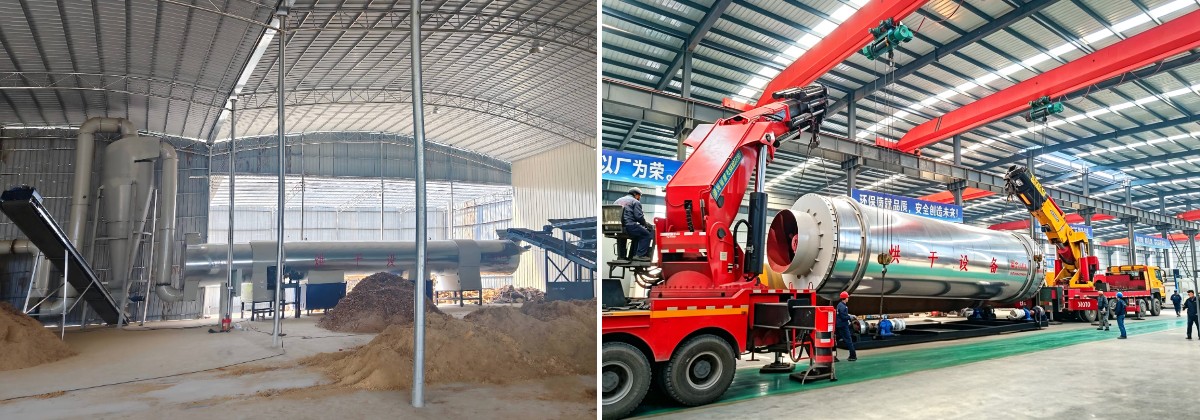
Efficient Drying for High-Moisture Manure
Unlike conventional industrial materials, cow manure has high moisture content, uneven texture, and relatively poor flowability. These characteristics place higher requirements on drying equipment.
The drying system is designed to provide sufficient contact between the material and hot air while continuously moving and dispersing the manure. This improves heat and mass transfer, allowing moisture to be removed more efficiently.
The system can be configured according to the customer's initial moisture content, required final moisture level, processing capacity, available heat source, and installation conditions. This customized approach is particularly important because different farms have very different manure characteristics and production targets.
Key Advantages of the Cow Manure Dryer
High-Efficiency Moisture Removal
The equipment is designed for high-moisture organic materials and can continuously remove excess water, helping improve downstream processing efficiency.
Continuous Industrial Operation
For medium- and large-scale livestock farms, continuous drying can better match daily manure collection and processing volumes, reducing manual handling.
Flexible Heat Source Options
The system can be matched with biomass burners, natural gas, coal alternatives, or other suitable heat sources according to local energy availability and environmental requirements.
Reduced Transportation Burden
After drying, the material becomes lighter and easier to transport, helping farms reduce the cost associated with moving high-moisture manure.
Suitable for Further Processing
Dried cow manure can be used as a feedstock for composting, organic fertilizer production, fertilizer granulation, or other resource utilization processes, depending on local regulations and the final application.
More Than a Dryer: A Complete Manure Processing Solution
For professional livestock waste treatment projects, purchasing a single machine is often not enough. A complete processing line may include manure collection, conveying, crushing or mixing, drying, screening, cooling, packaging, and fertilizer production equipment.
Yuchuan can design the equipment configuration according to the customer's actual production process. For example, farms with large quantities of wet manure may require a high-capacity conveying and drying system, while organic fertilizer manufacturers may need additional crushing, screening, and granulation equipment after drying.
This integrated approach makes the Cow Manure Dryer part of a complete resource utilization system rather than an isolated piece of equipment.
Applications in Different Industries
The equipment can be applied in a wide range of scenarios, including:
Dairy farms
Cattle farms
Large-scale livestock farms
Organic fertilizer production plants
Agricultural waste treatment projects
Composting facilities
Rural agricultural waste utilization projects
For dairy farms, drying can help improve manure management efficiency. For fertilizer manufacturers, properly dried manure provides a more convenient raw material for subsequent processing.
What Should Customers Consider Before Purchasing?
Selecting the right manure drying equipment requires more than simply comparing equipment dimensions or motor power. Several technical factors should be evaluated before confirming a project:
Material Conditions: Initial moisture, particle size, viscosity, and daily production.
Target Moisture: The required final moisture level depends on whether the dried manure will be stored, composted, granulated, or transported.
Heat Source: Local fuel availability and energy costs should be considered when selecting the heating system.
Processing Capacity: The dryer should match the actual daily manure output and allow reasonable production flexibility.
Environmental Requirements: Dust collection, exhaust treatment, and overall environmental performance should be incorporated into the system design.
Professional equipment manufacturers can use these parameters to develop a more suitable drying solution rather than simply supplying a standard machine.
Supporting Sustainable Agriculture
The development of efficient Cow Manure Dryer technology reflects a broader trend toward circular agriculture. Livestock manure is no longer viewed only as a waste material. Through proper treatment, it can become an important source of organic matter and nutrients.
By reducing moisture, improving handling efficiency, and preparing manure for subsequent utilization, drying technology helps connect livestock production with organic fertilizer manufacturing and agricultural resource recycling.
For farms looking to improve manure management while creating additional value from agricultural waste, an appropriately configured drying system can provide both environmental and economic benefits.