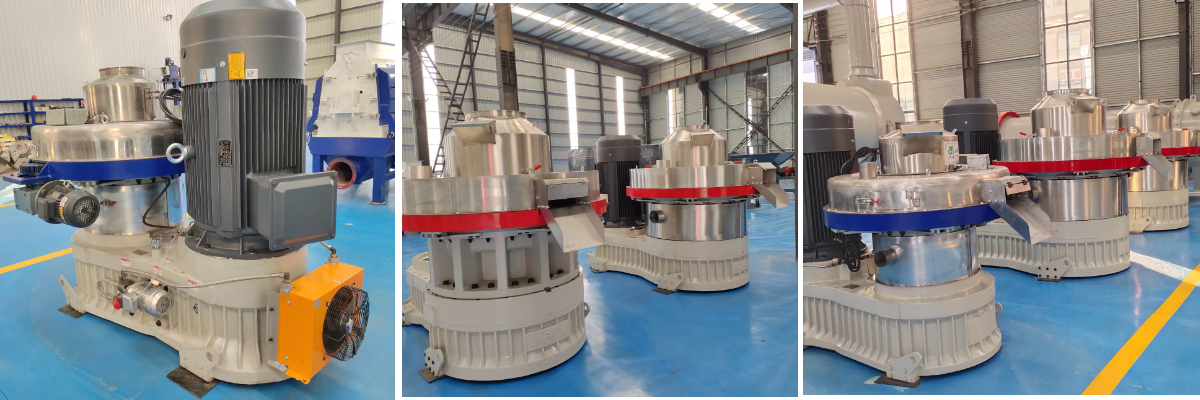
Ring Die Pellet Mill vs Flat Die Pellet Mill
Introduction
Pellet mills are core processing equipment in the biomass energy, livestock feed, and organic fertilizer industries. Currently, in the global market, ring-die pellet mills and flat-die pellet mills are the two mainstream types of pelletizing equipment with the highest market share. Each type has its own advantages and disadvantages in terms of structural principles, production performance, material compatibility, operating costs, and suitable applications. For overseas buyers, equipment distributors, and manufacturers, clearly understanding the distinguishing features of these two types of equipment is a key prerequisite for selecting cost-effective pelletizing equipment and optimizing production line configurations.
Working Principle & Structural Design
The ring die pelletizer features an integrated design combining a ring die with built-in press rollers. The machine uses a forced feeding system to convey raw materials into the compression chamber, where multiple sets of high-pressure rollers move in a circular motion along the inner wall of the ring die. These rollers apply high-intensity compression to the material, forcing it through the die holes to form pellets that are uniform in size and density.
Flat Die Pellet Mill
The flat-die pelletizer features a combination of a horizontal flat die and a vertical press roller. Raw materials automatically fall into the compaction zone under their own weight, while the rotating press roller applies downward pressure, forcing the material through the holes in the flat die to complete the pelletizing process. This model boasts a streamlined and compact design with a simple and intuitive mechanical layout. The machine is lightweight, easy to assemble and disassemble, and has a small footprint. It does not require complex supporting facilities, making it ideal for lightweight production scenarios such as small-scale processing plants and mobile production sites.
Production Capacity & Continuous Operation Performance
Ring Die Pellet Mill
Ring-die pellet mills are large-scale industrial pelletizing machines designed for round-the-clock, large-scale production. They are suitable for continuous operation and offer high production capacity. Equipped with a customized cooling system and high-strength, wear-resistant components, these machines maintain low failure rates during long-term, full-load operation and feature an extended service life. They are the equipment of choice for large-scale biomass pellet production lines, large-scale feed mills, and commercial organic fertilizer plants.
Flat Die Pellet Mill
Flat-die pelletizers are designed as small-scale pelletizing equipment suitable for intermittent production. Conventional models have low output capacity; due to limitations in the contact area between the pressure rollers and the flat die, there is a fixed upper limit to the equipment’s capacity, making them unsuitable for large-scale industrial production. The advantage of this model lies in its exceptional production flexibility, allowing for frequent changes in processed materials and easy start-up and shutdown. It is well-suited for the small-batch, multi-product production needs of small workshops and family farms.
Raw Material Adaptability
Ring Die Pellet Mill
The ring-die pellet mill is compatible with a wide range of raw materials, capable of processing the vast majority of biomass and feed materials, including wood chips, crop straw, rice husks, corn stalks, livestock and poultry manure, and mixed feed. The resulting pellets feature high density, uniform particle size, and a compact texture, offering a longer storage life and making them suitable for the production of high-quality, export-grade pellets. However, a drawback of this equipment is its strict requirements for raw material pretreatment; materials must be pre-crushed to a uniform fineness. It is not suitable for long-fiber raw materials with excessive coarseness, as this can easily lead to die blockage.
Flat Die Pellet Mill
The core advantage of the flat-die pellet mill lies in its ability to process coarse-fiber materials; it imposes virtually no strict requirements on the fineness of raw material grinding, allowing it to directly process agricultural waste and mixed raw materials that have not been finely ground, thereby greatly simplifying pre-production processes. For customers engaged in diversified production who need to frequently switch between feed, biomass fuel, and organic fertilizer raw materials, this model offers exceptional value for money. Its main drawback is that the finished pellets have relatively low density and overall hardness, making them unsuitable for producing high-hardness, high-density premium pellets for export.
Summary & Purchasing Recommendations
There is no absolute good or bad between the two types of pellet mills. Purchasers shall select equipment accurately based on their own production scale, raw material type, project budget and operation mode instead of blind purchasing.
Prioritize purchasing ring-die pellet mills if:
1.Annual production exceeds 10,000 tons and the equipment needs to operate continuously for extended periods;
2.Products are intended for export or high-end end markets, with strict requirements for pellet density, appearance, and hardness;
3. The project has a sufficient budget and can employ dedicated maintenance and operations personnel;
4.The raw materials to be processed are primarily fine-grained materials such as conventional wood chips and feed mixtures with standard ratios.
Prioritize purchasing a horizontal die pellet mill if:
1.Production capacity requirements are low, production is intermittent, and frequent changes in processed materials are required;
2. Budget is limited, factory space is small, and there are no specialized equipment operators;
3. The primary materials processed are coarse-fiber agricultural waste and mixed by-products;
4. The machine is intended for on-farm use, local retail sales to small-scale farmers, or preliminary trial production for new projects.