One Dryer, Multiple Materials: What Can Industrial Drying Equipment Handle?
Industrial drying is an important step in biomass processing, agricultural waste utilization, feed production, and many other industries. However, different materials have different moisture contents, particle sizes, densities, and drying characteristics. This means that choosing suitable Industrial Drying Equipment is essential for stable production and consistent final moisture.
For many customers, the question is not simply “Can the dryer dry my material?” More importantly, it is whether the equipment can achieve continuous drying, uniform moisture control, stable operation, and reasonable energy consumption under actual production conditions.
Shandong Yuchuan provides customized industrial drying solutions for different materials and processing requirements. Depending on the material characteristics, production capacity, inlet moisture, target moisture, and available heat source, the drying system can be configured accordingly.
1. Wood Chips and Sawdust
Wood chips and sawdust are common biomass materials used for fuel pellets, animal bedding, and other biomass applications. Fresh wood materials may contain relatively high moisture, which can affect subsequent pelletizing and storage.
A Wood Chip Dryer or Sawdust Dryer can continuously reduce moisture before further processing. Proper drying helps improve material flowability and creates more stable conditions for pellet mills and other downstream equipment.
For sawdust and small particles, drying airflow, temperature, feeding rate, and residence time need to be coordinated to achieve uniform drying while reducing material loss.
2. Straw and Agricultural Residues
Straw, corn stalks, cotton stalks, rice husks, and other agricultural residues are widely available biomass resources.
Before pelletizing, briquetting, combustion, or other utilization processes, excessive moisture may reduce processing efficiency. Industrial drying equipment can be integrated into a biomass processing line to reduce moisture to a suitable level.
For materials with different particle sizes and structures, the drying system can be adjusted according to the material properties and required production capacity.
This makes a Biomass Dryer an important supporting machine for biomass fuel production lines.
3. Coconut Coir and Palm Fiber
Coconut coir and palm fiber are another group of fibrous materials that often require moisture reduction before further processing.
Because fibrous materials may have uneven moisture distribution and relatively loose structures, the drying process needs sufficient hot-air contact and controlled material movement.
A properly configured Industrial Dryer can help improve drying uniformity while supporting continuous large-scale production.
For coconut coir, palm fiber, and similar biomass materials, the drying system can also be combined with dust collection equipment to create a cleaner production environment.
4. Brewer’s Spent Grain and Other High-Moisture Materials
Some industrial materials are more difficult to dry because of their high initial moisture content or sticky characteristics.
Brewer’s spent grain is a typical example. After brewing, the material contains considerable moisture and needs to be dried quickly if it is intended for feed, fuel, or other applications.
Similar challenges can occur with materials such as organic residues, certain agricultural by-products, and other high-moisture biomass materials.
For these materials, the key is not simply increasing the drying temperature. Instead, the overall system needs to consider feeding, hot-air distribution, material movement, residence time, and moisture control.
A customized Industrial Drying Equipment solution can help reduce problems such as uneven drying, excessive energy consumption, and material accumulation.
5. Chicken Manure and Organic Materials
Chicken manure and other organic materials can also be processed through industrial drying systems before further utilization.
Drying can reduce moisture and make the material easier to store, transport, granulate, or process into other products.
Because organic materials may contain high moisture and produce dust or odor during processing, the complete system can be designed with suitable feeding, drying, discharge, and dust-control equipment.
This is particularly important for customers planning complete manure drying and granulation projects.
6. Sludge and Other Difficult-to-Dry Materials
Industrial sludge usually has high moisture and may have poor flowability, making it more challenging than conventional biomass materials.
For sludge and similar materials, drying performance depends on material properties, moisture content, feeding conditions, and the selected drying process.
A complete drying system should therefore be designed according to the actual material instead of simply using a standard machine configuration.
For high-moisture and difficult-to-dry materials, Yuchuan can adjust the equipment configuration according to project requirements, helping customers achieve more stable continuous processing.
What Determines Whether One Dryer Can Handle Different Materials?
Although one type of industrial dryer may be suitable for different materials, the configuration should not be exactly the same for every application.
Several factors should be considered:
Material Moisture:
Initial and target moisture directly affect drying capacity and energy requirements.
Particle Size:
Smaller particles generally have a larger contact area with hot air, while larger or irregular materials may require different residence times.
Material Structure:
Fibrous, granular, sticky, and powdery materials behave differently during drying.
Production Capacity:
A system designed for 2 tons per hour may be very different from one designed for 10 or 20 tons per hour.
Heat Source:
Biomass burners, hot air furnaces, gas, and other heat sources can be selected according to local conditions and project requirements.
Final Moisture Requirement:
The target moisture depends on the final application, such as pelletizing, combustion, feed production, storage, or transportation.
More Than a Dryer: A Complete Drying Solution
For industrial customers, a dryer is only one part of the complete processing system.
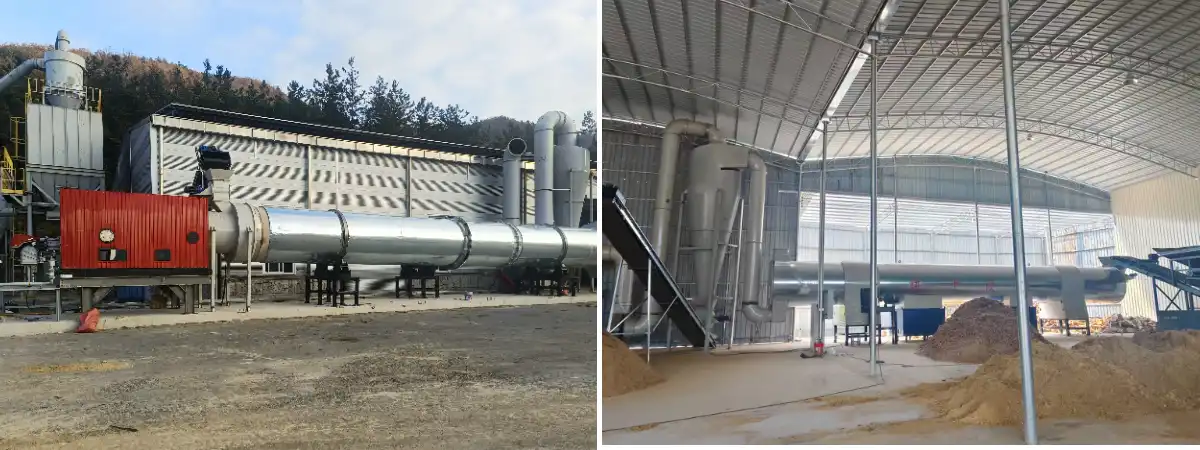
A practical drying project may include feeding equipment, crushing equipment, a heat source, an Industrial Dryer, dust collection equipment, conveying systems, and automatic control components.
For example, a biomass pellet production line may require:
Raw Material → Crushing → Drying → Pelletizing → Cooling → Screening → Packaging
In this process, stable drying is directly connected with the performance of downstream pelletizing equipment.
Therefore, selecting Industrial Drying Equipment according to the complete production process is often more important than choosing a dryer based only on capacity.
Yuchuan Industrial Drying Equipment
Shandong Yuchuan focuses on drying and biomass processing equipment and provides customized solutions for different raw materials and production requirements.
The company’s drying equipment can be applied to a wide range of materials, including wood chips, sawdust, straw, coconut coir, palm fiber, brewer’s spent grain, chicken manure, sludge, and other biomass or industrial materials.
Based on material characteristics and customer requirements, Yuchuan can help configure suitable drying capacity, heat-source systems, feeding and conveying equipment, and dust-control systems.
The goal is not simply to dry materials, but to create a stable, efficient, and practical drying process that can be integrated into the customer’s complete production line.
Conclusion
Can one dryer handle multiple materials?
The answer depends on the material characteristics and system configuration. Different materials require different approaches to moisture control, hot-air distribution, feeding, and residence time.
From wood chips and sawdust to coconut coir, palm fiber, agricultural residues, brewer’s spent grain, chicken manure, and sludge, professional Industrial Drying Equipment can be configured for a wide range of processing applications.
For customers planning a new drying project, the most important step is to evaluate the material, moisture, capacity, heat source, and final application before selecting the equipment.
With the right configuration, one industrial drying platform can support multiple material-processing applications while helping businesses improve production efficiency and resource utilization.