How to Improve Drying Efficiency for Biomass Materials? Key Factors to Consider
As the demand for biomass energy, animal bedding, feed production, and agricultural waste recycling continues to grow, efficient drying has become an important part of biomass material processing. Materials such as wood chips, sawdust, straw, palm fiber, coconut coir, bagasse, peanut shells, and other agricultural residues often contain high and uneven moisture levels, which can affect subsequent processing.
For biomass processing plants, choosing a suitable biomass dryer is not simply about removing water. Drying efficiency, energy consumption, material adaptability, final moisture content, and equipment stability all need to be considered.
So, how can companies improve drying efficiency while maintaining stable production? Here are several key factors.
1. Understand the Initial Moisture Content
Different biomass materials have different moisture characteristics. Fresh agricultural residues may contain a relatively high amount of water, while processed sawdust or wood chips may have a lower moisture content.
Before selecting a biomass dryer, users should determine the initial moisture content, required final moisture content, processing capacity, and material properties. These parameters directly affect dryer configuration and heat consumption.
For example, materials intended for pellet production normally require controlled moisture before entering the pellet mill. If the material is too wet, pellet formation and production efficiency can be affected. If it is excessively dry, unnecessary energy consumption may occur.
Therefore, moisture control is one of the first factors to consider when designing a drying process.
2. Match the Dryer with the Material
Not all biomass materials behave the same way during drying.
Wood chips and sawdust are relatively common materials for industrial drying, while coconut coir, palm fiber, bagasse, sludge, and other high-moisture materials may have different flowability and heat-transfer characteristics.
A suitable industrial dryer should be selected according to material size, moisture content, density, stickiness, heat sensitivity, and required production capacity.
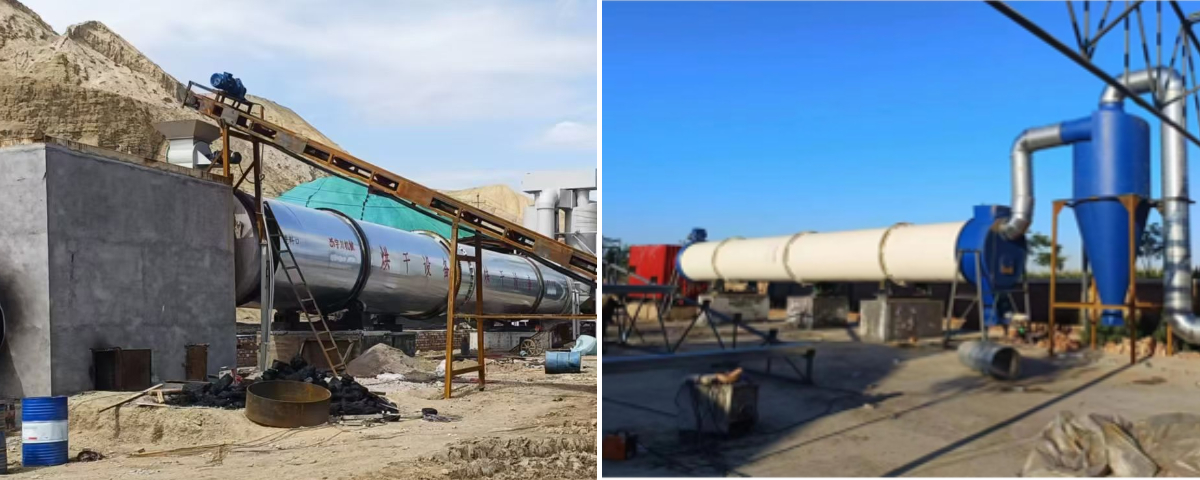
For materials with higher moisture or more complex physical properties, a properly designed rotary drying system can provide continuous material movement and improve contact between hot air and the material.
3. Improve Heat Transfer Efficiency
Heat transfer is at the core of industrial drying.
An efficient drying system should allow hot air to contact the material sufficiently while maintaining an appropriate temperature and airflow. Poor heat distribution can result in some material being overdried while other material remains too wet.
Modern drying systems can optimize the internal structure of the drying drum, material lifting and dispersion, hot-air circulation, and residence time. These improvements help create a more stable drying environment.
For biomass applications, efficient heat transfer is particularly important because many raw materials have irregular shapes and relatively low bulk density.
4. Control the Drying Temperature
Higher temperature does not always mean faster or better drying.
Different materials require different drying conditions. Excessive temperature may affect material quality, while insufficient temperature can reduce drying efficiency.
A reliable biomass dryer should provide controllable drying conditions according to the characteristics of the raw material.
For biomass pellet production, for example, maintaining suitable moisture before pelletizing can help improve the stability of the subsequent production process. Therefore, temperature control and moisture control should work together rather than being considered separately.
5. Consider Energy Consumption
Energy consumption is another major concern for biomass processing plants.
A drying system with poor thermal efficiency may require more fuel to achieve the same moisture reduction, increasing operating costs.
Energy-saving drying solutions can improve heat utilization through optimized hot-air circulation, suitable heat-source matching, improved drum design, and better insulation.
For large-scale production, even a small improvement in thermal efficiency can have a noticeable effect on long-term operating costs.
6. Integrate Drying with the Complete Production Line
For many biomass projects, the dryer is only one part of the complete processing system.
A typical biomass pellet production line may include crushing, drying, conveying, pelletizing, cooling, screening, and packing equipment.
In this situation, the capacity of the biomass dryer should match the upstream and downstream equipment. If the dryer capacity is too small, it may become a production bottleneck. If it is oversized, the initial investment and energy consumption may increase unnecessarily.
Therefore, integrated production-line design can be more practical than selecting individual machines separately.
7. Choose a Dryer Manufacturer with Project Experience
Equipment quality is important, but project design and technical support are equally important.
A professional dryer manufacturer should be able to evaluate raw materials, production capacity, moisture requirements, heat sources, plant conditions, and downstream applications before recommending equipment.
For international buyers, additional factors such as equipment transportation, installation guidance, spare parts, technical support, and after-sales service should also be considered.
Yuchuan Biomass Drying Solutions
Yuchuan focuses on drying and biomass processing equipment for different raw materials and production requirements. Its drying solutions can be adapted for materials such as wood chips, sawdust, straw, palm fiber, coconut coir, bagasse, peanut shells, and other biomass residues.
Depending on the project requirements, the drying system can be integrated with crushing, conveying, pelletizing, heat-source, dust-removal, and other supporting equipment to create a complete biomass processing solution.
For overseas buyers, customized equipment selection can be based on material type, initial and final moisture content, required capacity, available heat source, and installation conditions.
If you are planning a new biomass drying project or upgrading an existing production line, choosing the right biomass dryer at the beginning can help improve production stability, energy utilization, and final product quality.